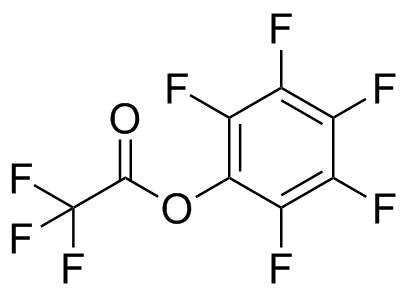
Pentafluorophenyl trifluoroacetate has eight fluorine atoms arranged in two chemically distinct regions. Five replace the hydrogens of a phenyl ring. Three occupy a trifluoromethyl group on the acid-derived side of an ester. The connection is CF₃–C(=O)–O–C₆F₅, giving the formula C₈F₈O₂. There are no hydrogens in the neutral molecule. Despite the similar words in its name, it is neither pentafluorophenol nor trifluoroacetic acid, and it is not merely a mixture of those two components.
The fluorines affect the ester's electronic environment. The trifluoromethyl group withdraws electron density near the carbonyl, while the fluorinated phenoxy group can provide a leaving group in acyl-substitution chemistry. These features help account for interest in it as a reagent. The location of an incoming bond matters: transferring an acyl group and substituting a fluorine on the ring would be different transformations. A count of fluorine atoms cannot identify which transformation has occurred.
A documented application is preparation of pentafluorophenyl esters of Fmoc-protected amino acids. A 1990 Tetrahedron Letters paper specifically described using this reagent for that purpose. In the resulting activated amino acid ester, the carbonyl portion comes from the amino acid and the pentafluorophenoxy portion provides the leaving group. It is not the same ester as the trifluoroacetate starting reagent. The distinction makes the method easier to understand: a reactive tool is being used to prepare a different, useful acyl donor for peptide chemistry.
An activated ester can subsequently react with an appropriate amine to form an amide. For an amino acid derivative, that is a route toward peptide-bond construction, provided the amino group and other functions have been managed appropriately. The successful use of one activated ester in a published preparation does not make every substrate equally compatible or establish that stereochemistry is retained under all conditions.
This molecule's story is therefore about controlled transfer and activation, rather than a biological effect of a fluorinated ingredient. Its structure supplies a well-defined reagent, and the literature documents a specific way that reagent helps turn a protected amino acid into another synthetic building block.
References:
1. PubChem. Pentafluorophenyl trifluoroacetate, CID 4327891. https://pubchem.ncbi.nlm.nih.gov/compound/4327891
2. Preparation of pentafluorophenyl esters of FMOC protected amino acids with pentafluorophenyl trifluoroacetate. Tetrahedron Lett. 1990;31:5851–5852. https://doi.org/10.1016/S0040-4039(00)97976-0
3. Encyclopedia of Reagents for Organic Synthesis. Pentafluorophenyl trifluoroacetate. https://doi.org/10.1002/047084289X.rn02081
|






 GHS02;GHS07 WarningGHS02; Details
 chemBlink Chemical Story