
Online Database of Chemicals from Around the World
| Taizhou KEDE Chemical Co., Ltd. | China | Inquire | ||
|---|---|---|---|---|
 | www.kedechemical.com | |||
 | +86 (576) 8461-3060 +86 13093829633 | |||
 | +86 (576) 8461-3060 | |||
 | sales@kedechemical.com | |||
 | QQ Chat | |||
 | WeChat: 13093829633 | |||
| Chemical distributor since 2013 | ||||
| chemBlink Standard supplier since 2014 | ||||
| Shanghai Forever Synthesis Co.,Ltd. | China | Inquire | ||
|---|---|---|---|---|
| www.foreversyn.com | |||
| +86 (551) 6288-8437 +86 18096409024 | |||
| sales@foreversyn.com sales02@foreversyn.com | |||
| QQ Chat | |||
 | Skype Chat | |||
| Chemical distributor since 2013 | ||||
| chemBlink Standard supplier since 2018 | ||||
| Classification | Biochemical >> Inhibitor >> Transmembrane transporters >> CFTR activator |
|---|---|
| Name | 15beta-Travoprost |
| Synonyms | (5Z)-7-[(1R,2R,3R,5S)-3,5-Dihydroxy-2-[(1E,3S)-3-hydroxy-4-[3-(trifluoromethyl)phenoxy]-1-buten-1-yl]cyclopentyl]-5-heptenoic acid 1-methylethyl ester |
| Molecular Structure | 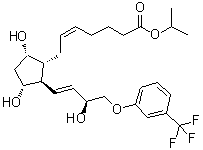 |
| Molecular Formula | C26H35F3O6 |
| Molecular Weight | 500.55 |
| CAS Registry Number | 1420791-14-5 |
| EC Number | 810-030-3 |
| SMILES | CC(C)OC(=O)CCC/C=CC[C@H]1[C@H](C[C@H]([C@@H]1/C=C/[C@@H](COC2=CC=CC(=C2)C(F)(F)F)O)O)O |
| Density | 1.2±0.1 g/cm3 Calc.* |
|---|---|
| Boiling point | 584.8±50.0 °C 760 mmHg (Calc.)* |
| Flash point | 307.5±30.1 °C (Calc.)* |
| Solubility | Insoluble (4.2E-3 g/L) (25 °C), Calc. |
| Index of refraction | 1.547 (Calc.)* |
| * | Calculated using Advanced Chemistry Development (ACD/Labs) Software. |
| Hazard Symbols |  GHS07 Warning Details GHS07 Warning Details |
|---|---|
| Risk Statements | H302 Details |
| Safety Statements | P264-P270-P301+P317-P330-P501 Details |
 Discovery and Applications
|
15β-Travoprost is a synthetic structural analog of prostaglandin F2α (PGF2α) and belongs to the class of isopropyl ester prodrugs developed for ocular hypotensive therapy. It is chemically related to travoprost, a clinically established agent used for reducing intraocular pressure in patients with open-angle glaucoma or ocular hypertension. The 15β designation refers to the configuration at the C-15 carbon atom on the prostaglandin skeleton, indicating a stereochemical inversion from the natural 15α orientation. This modification has been examined in experimental pharmacological and biochemical studies to evaluate the structure–activity relationship of prostaglandin analogs acting on FP-type prostanoid receptors in ocular tissues. Travoprost itself is an isopropyl ester prodrug of the free acid known as travoprost acid. After topical administration, the ester is hydrolyzed by ocular esterases to yield the biologically active free acid form, which is a potent agonist at FP prostanoid receptors located in the ciliary muscle and trabecular meshwork. Activation of these receptors increases uveoscleral and trabecular outflow of aqueous humor, leading to a sustained reduction in intraocular pressure. The discovery of travoprost followed extensive research into prostaglandin F2α analogs designed to improve ocular penetration, enhance receptor selectivity, and reduce systemic side effects compared to naturally occurring prostaglandins. Studies on 15β-substituted analogs such as 15β-travoprost were performed to investigate the influence of stereochemistry at the C-15 position on receptor binding and pharmacological activity. Research demonstrated that while the natural 15α-configuration of PGF2α and its analogs generally confers optimal FP receptor activity, certain 15β-isomers can retain partial agonist activity or exhibit altered potency and metabolic stability. Synthetic modifications at the C-15 position have also been used to modulate resistance to enzymatic oxidation, affecting the compound’s duration of action. These stereochemical studies contributed to the understanding of the structure–activity relationships that guide the design of prostaglandin-based ocular hypotensive drugs. Pharmacologically, 15β-travoprost acts through the same general mechanism as travoprost by increasing aqueous humor outflow, but comparative data from receptor binding and tissue assays have shown that inversion at the C-15 position can reduce intrinsic efficacy at FP receptors. Studies using cloned human FP receptor systems and ex vivo ocular tissue models confirmed that 15β-analogs often exhibit lower receptor affinity and decreased potency relative to their 15α-counterparts. Despite this, the compound has been valuable in defining the spatial requirements for FP receptor activation and contributes to the broader knowledge base guiding the synthesis of next-generation prostaglandin analogs with improved therapeutic profiles. The synthesis of 15β-travoprost follows the same general methodology as that of travoprost, involving stereoselective construction of the cyclopentane core, controlled introduction of hydroxyl substituents, and isopropyl ester formation. Key steps include enantioselective oxidation and reduction reactions to ensure the correct configuration at C-15, followed by coupling of the omega-chain side group containing a phenyl substituent that characterizes travoprost derivatives. Analytical characterization by NMR and chiral chromatography confirms the inversion at the C-15 stereocenter. In summary, 15β-travoprost is an experimental stereoisomeric derivative of travoprost, designed to investigate the role of C-15 configuration in prostaglandin receptor activity. Although it has not been developed as a therapeutic product, studies on this compound have provided fundamental insight into prostaglandin stereochemistry, receptor selectivity, and metabolic behavior that underlie the pharmacological optimization of ocular hypotensive agents. References Peng H, Chen F‑E (2017) Recent advances in asymmetric total synthesis of prostaglandins. Org. Biomol. Chem. 15 6281– 6301 DOI: 10.1039/C7OB01341H |
| Market Analysis Reports |
| List of Reports Available for 15beta-Travoprost |