
Online Database of Chemicals from Around the World
| BOC Sciences | USA | Inquire | ||
|---|---|---|---|---|
 | www.bocsci.com | |||
 | +1 (631) 485-4226 | |||
 | +1 (631) 614-7828 | |||
 | info@bocsci.com | |||
| Chemical manufacturer | ||||
| chemBlink Standard supplier since 2010 | ||||
| Shanghai Worldyang Chemical Co., Ltd. | China | Inquire | ||
|---|---|---|---|---|
| www.worldyachem.com | |||
| +86 13651600618 +86 (21) 5679-5779 | |||
| +86 (21) 5679-5266 | |||
| sales7777@worldyachem.com | |||
 | QQ Chat | |||
 | WeChat: 13651600618 | |||
 | WhatsApp:+86 13651600618 | |||
| Chemical manufacturer since 2012 | ||||
| Classification | Food additive >> Enzyme |
|---|---|
| Name | E3 ligase Ligand 1A |
| Synonyms | (2S,4R)-1-[(2S)-2-amino-3,3-dimethylbutanoyl]-4-hydroxy-N-[(1S)-1-[4-(4-methyl-1,3-thiazol-5-yl)phenyl]ethyl]pyrrolidine-2-carboxamide |
| Molecular Structure | 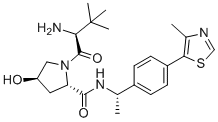 |
| Molecular Formula | C23H32N4O3S |
| Molecular Weight | 444.59 |
| CAS Registry Number | 1948273-02-6 |
| EC Number | 879-770-2 |
| SMILES | CC1=C(SC=N1)C2=CC=C(C=C2)[C@H](C)NC(=O)[C@@H]3C[C@H](CN3C(=O)[C@H](C(C)(C)C)N)O |
| Density | 1.2±0.1 g/cm3, Calc.* |
|---|---|
| Index of Refraction | 1.596, Calc.* |
| Boiling Point | 687.9±55.0 °C (760 mmHg), Calc.* |
| Flash Point | 369.8±31.5 °C, Calc.* |
| * | Calculated using Advanced Chemistry Development (ACD/Labs) Software. |
| Hazard Symbols |  GHS07 Warning Details GHS07 Warning Details | ||||||||||||||||
|---|---|---|---|---|---|---|---|---|---|---|---|---|---|---|---|---|---|
| Risk Statements | H302-H315-H319-H335 Details | ||||||||||||||||
| Safety Statements | P261-P305+P351+P338 Details | ||||||||||||||||
| Hazard Classification | |||||||||||||||||
| |||||||||||||||||
| SDS | Available | ||||||||||||||||
 Discovery and Applications
|
E3 Ligase Ligand 1A is an important molecule in the field of targeted protein degradation, a cutting-edge strategy for regulating cellular protein levels. The concept of using small molecules for targeted protein degradation emerged in the early 21st century, leading to the discovery of E3 Ligase Ligand 1A. Researchers aim to develop molecules that can exploit the cellular machinery to selectively degrade target proteins. E3 Ligase Ligand 1A utilizes E3 ubiquitin ligases to target proteins, marking them for proteasomal degradation. E3 Ligase Ligand 1A contains the binding domain of an E3 ubiquitin ligase and a linker attached to a moiety that interacts with the target protein or other functional groups. E3 Ligase Ligand 1A is an important component of proteolysis targeting chimeras (PROTACs), which are bifunctional molecules. PROTACs use E3 Ligase Ligand 1A to bind to an E3 ubiquitin ligase and attach it to a target protein, inducing ubiquitination and subsequent proteasomal degradation of the target protein. This approach allows for the selective degradation of proteins, including those previously considered "undruggable." It can be used in cancer treatment, neurodegenerative diseases, and other diseases associated with abnormal protein levels. In oncology, PROTACs based on E3 ligase ligand 1A are used to degrade oncogenic proteins, thereby inhibiting tumor growth. This approach provides a new way to address drug resistance and improve the efficacy of cancer treatments. By degrading aggregated or misfolded proteins in neurodegenerative diseases such as Alzheimer's and Parkinson's, E3 ligase ligand 1A provides a potential therapeutic strategy for treating these diseases. E3 ligase ligand 1A is used to study protein function by controlling protein degradation in cells. This allows researchers to dissect the role of specific proteins in various cellular processes. It allows the study and manipulation of biological pathways by selectively degrading pathway components, providing insights into the mechanisms behind various physiological and pathological conditions. Tools based on E3 ligase ligand 1A are used in proteomics to degrade and study protein complexes and interactions, helping to identify new biomarkers and therapeutic targets. It helps validate biomarkers by degrading proteins identified as potential biomarkers in disease, confirming their role and importance in disease pathology. In agricultural biotechnology, E3 ligase ligand 1A can be used to degrade proteins that contribute to crop resistance to insects or stress responses, thereby improving yield and resilience. It is used to develop biotechnological applications such as engineering plants and microbes to obtain desired traits by controlling protein levels through targeted degradation. References 2020. Understanding the Metabolism of Proteolysis Targeting Chimeras (PROTACs): The Next Step toward Pharmaceutical Applications. Journal of Medicinal Chemistry, 63(20). DOI: 10.1021/acs.jmedchem.0c00793 2018. Design and Synthesis of Proteolysis Targeting Chimeras for Inducing BRD4 Protein Degradation. Chemical Research in Chinese Universities, 34(2). DOI: 10.1007/s40242-018-7299-7 2020. The First SHP2 PROTAC. Synfacts. DOI: 10.1055/s-0040-1706809 |
| Market Analysis Reports |
| List of Reports Available for E3 ligase Ligand 1A |