
Online Database of Chemicals from Around the World
| Targetmol Chemicals Inc. | USA | Inquire | ||
|---|---|---|---|---|
 | www.targetmol.com | |||
 | +1 (781) 999-5354 | |||
 | +1 (781) 281-9145 | |||
 | sales@targetmol.com | |||
| Chemical manufacturer since 2013 | ||||
| chemBlink Standard supplier since 2025 | ||||
| Classification | Biochemical >> Antibody >> Stem cells, development and differentiation |
|---|---|
| Name | IAG933 |
| Synonyms | 4-[(2S)-5-chloro-6-fluoro-2-phenyl-2-[(2S)-pyrrolidin-2-yl]-3H-1-benzofuran-4-yl]-5-fluoro-6-(2-hydroxyethoxy)-N-methylpyridine-3-carboxamide |
| Molecular Structure | 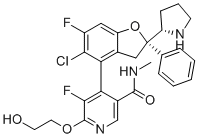 |
| Molecular Formula | C27H26ClF2N3O4 |
| Molecular Weight | 529.96 |
| CAS Registry Number | 2714434-21-4 |
| SMILES | CNC(=O)C1=CN=C(C(=C1C2=C3C[C@@](OC3=CC(=C2Cl)F)([C@@H]4CCCN4)C5=CC=CC=C5)F)OCCO |
| Hazard Symbols |  GHS07 Warning Details GHS07 Warning Details |
|---|---|
| Risk Statements | H302-H315-H319 Details |
| Safety Statements | P501-P270-P264-P280-P302+P352-P337+P313-P305+P351+P338-P362+P364-P332+P313-P301+P312+P330 Details |
| SDS | Available |
 Discovery and Applications
|
IAG933 is a small-molecule inhibitor developed to directly disrupt the protein-protein interaction (PPI) between YAP/TAZ coactivators and TEAD transcription factors. This interaction is a critical component of the Hippo signaling pathway, which regulates cell growth and organ size. Dysregulation of this pathway, often through mutations in NF2, LATS1/2, or YAP/TAZ fusions, can lead to uncontrolled cell proliferation and tumorigenesis. IAG933 was identified as a potent and selective disruptor of the YAP–TEAD interface, offering a novel approach to target Hippo pathway alterations in cancer. The discovery of IAG933 involved screening for compounds that could bind to the TEAD-binding pocket, thereby preventing the association between YAP/TAZ and TEADs. This direct inhibition contrasts with previous strategies that targeted the TEAD lipid-binding pocket, offering a more specific and potentially more effective means to modulate YAP/TAZ activity. IAG933 demonstrated high affinity for all four TEAD paralogs, leading to the eviction of YAP from chromatin and a reduction in Hippo-mediated transcription, which is associated with tumor progression. In preclinical studies, IAG933 exhibited significant anti-tumor activity in models of mesothelioma, a cancer often driven by Hippo pathway alterations. Treatment with IAG933 resulted in deep tumor regression at tolerated doses, highlighting its potential as a therapeutic agent. Additionally, combining IAG933 with other targeted therapies, such as those inhibiting receptor tyrosine kinases or KRAS mutations, enhanced anti-tumor efficacy, suggesting that IAG933 could be used in combination therapies to overcome resistance mechanisms in various cancers. As of 2024, IAG933 is undergoing Phase I clinical trials to evaluate its safety, tolerability, and preliminary anti-tumor activity in patients with advanced mesothelioma and other solid tumors harboring specific molecular alterations in the Hippo pathway. These trials aim to determine the maximum tolerated dose and assess the compound's potential as a treatment option for cancers associated with Hippo pathway dysregulation. IAG933 represents a significant advancement in cancer therapy by targeting the YAP/TAZ–TEAD interaction, a previously challenging but crucial component of tumorigenic signaling. Its development underscores the importance of targeting specific molecular interactions to develop more effective and precise cancer treatments. References 2024. Direct and selective pharmacological disruption of the YAP-TEAD interface by IAG933 inhibits Hippo-dependent and RAS-MAPK-altered cancers. Nature Cancer, 5(6). DOI: 10.1038/s43018-024-00754-9 |
| Market Analysis Reports |
| List of Reports Available for IAG933 |